Traditions and symbols of Russia
The headscarf is an element of traditional costume in many nations around the world, reflecting a connection to folk customs since ancient times. The exhibition of headscarf paintings is organized by the RUDN University Research Library in collaboration with the Fashion House of designer Nina Ruchkina. The headscarves are dedicated to Russia's cultural heritage, revealing the richness of Russia's unique heritage through images of folklore and art, depictions of state symbols, and international motifs in the context of a dialogue of cultures. They are included in museum collections, souvenir collections, and are owned by top government officials.
The exhibition consists of four sections
Section I "Tales and Legends of Russia"
visually reproduces cultural codes that have historically served as an inexhaustible source of knowledge, traditions, and customs passed down from generation to generation.
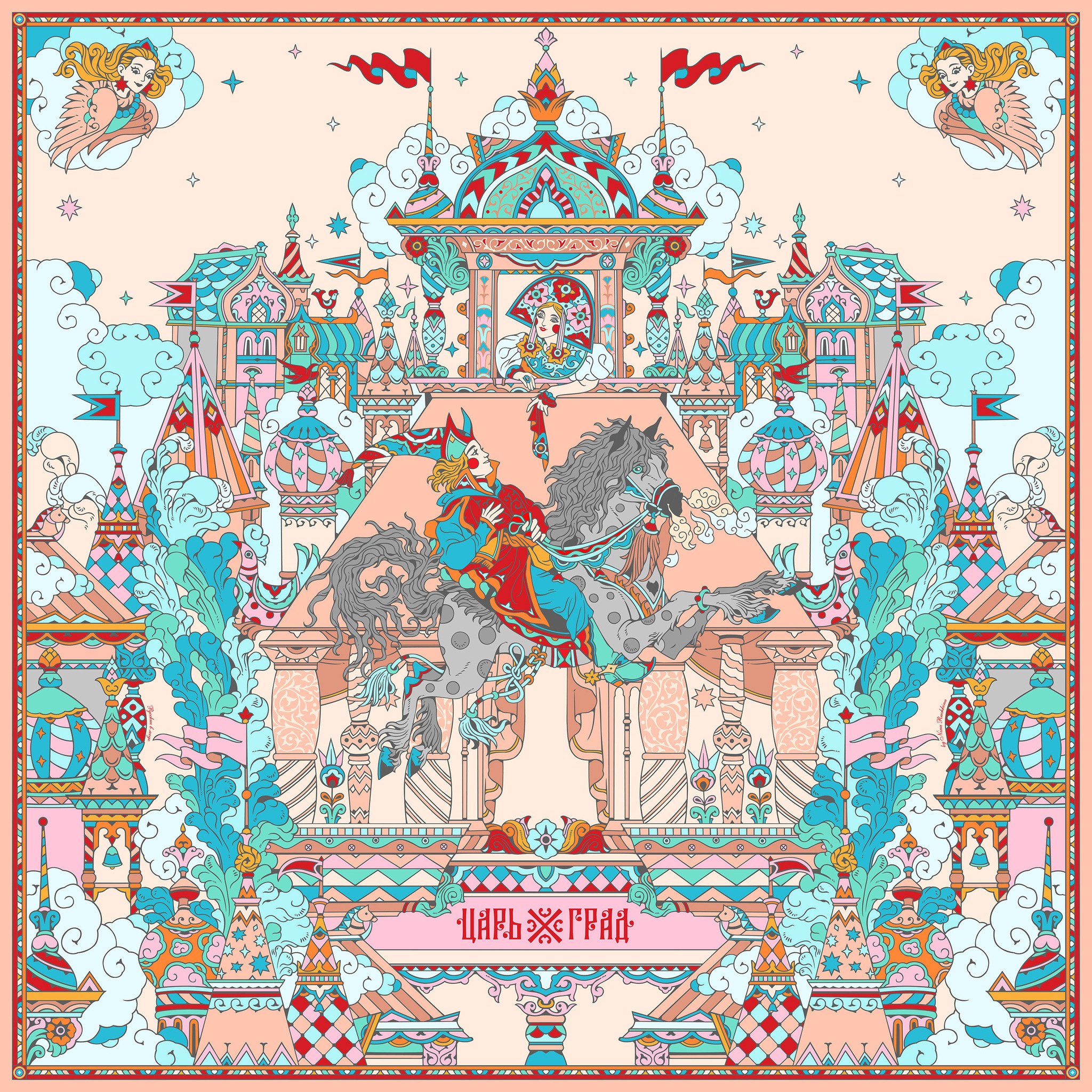
"Tsargrad" Shawl
The "Tsargrad" shawl is distinguished by its vibrant colors, exquisite craftsmanship, and the atmosphere of a true Russian fairy tale. The pictorial motif draws on the folk tradition of witchcraft. The plot illustrates a scene from the folklore tale "Sivka-Burka" about the triumph of true love and the fulfillment of desires.
In the center of the canvas rises the magical tower of Tsargrad, with its multicolored towers and painted pillars in the old Russian style, surrounded by exotic plants. Ivan, having overcome all trials, rushes toward the beautiful princess on a frisky horse. Everything in Tsargrad is filled with an atmosphere of joy, celebration, and the anticipation of imminent miracles!
Tsargrad. Designer Nina Ruchkina, artist Mila Losenko. 90x90 cm
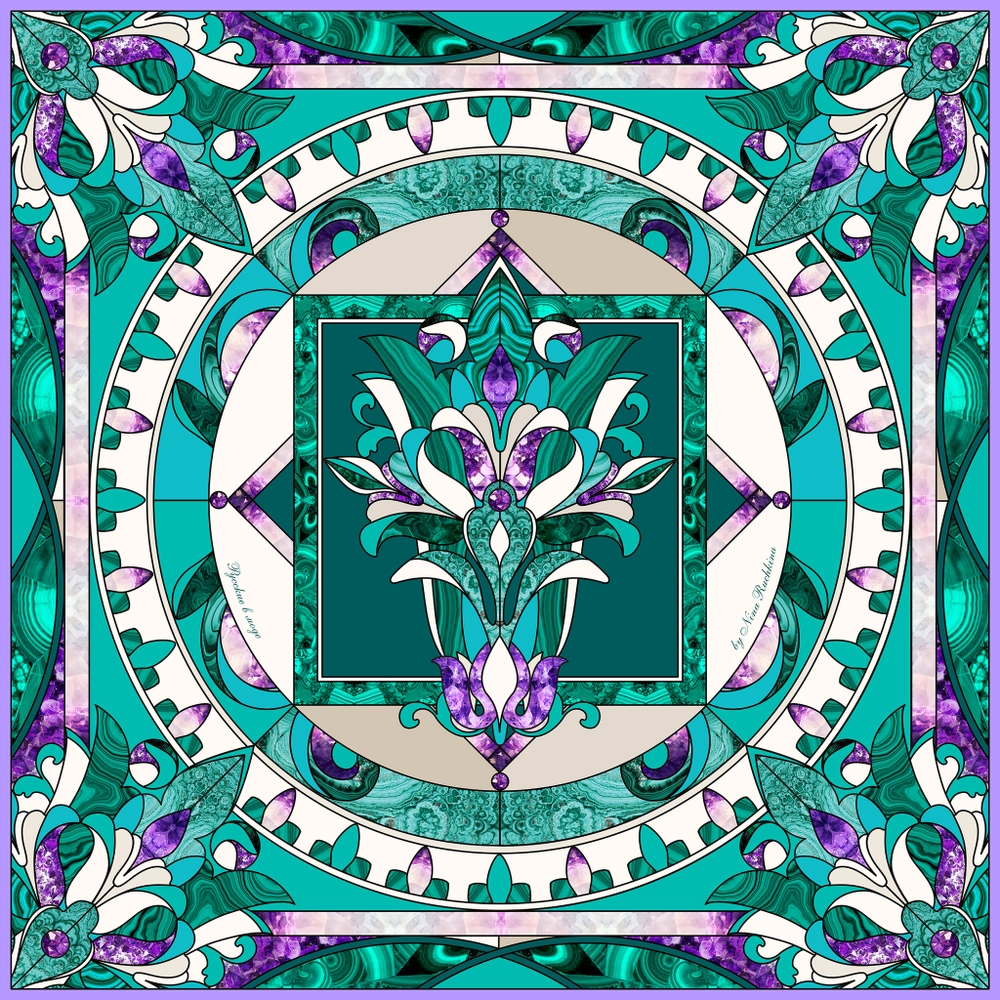
"Stone Flower" Scarf
"My admiration for the Ural culture and my love for my native land inspired the creation of this scarf. The Ural magic of the place, ancient tales, and the richness of the mountain's depths are embodied in the Stone Flower!" - Designer Nina Ruchkina
The "Stone Flower" scarf reveals the treasure trove of the gardens of the Mistress of the Copper Mountain, which has long embodied an inexhaustible source of inspiration in the Urals. The scarf's main image is inspired by the tale of the Stone Flower – a symbol of creative exploration and perfection. This work is part of the collection "Malachite Box" by the regional classic, Ural "genius loci" writer P.P. Bazhov (1879-1950), who drew on folklore to create a timeless epic about the Urals.
The mosaic of the Mistress's Flower, depicted on the canvas, contains Ural gemstones of amethyst and copper emerald, believed to possess exceptional magical powers. The flower is framed by a border of patterned malachite—the symbol of the Mistress of the Mountain and the Urals as a whole.
The "Stone Flower" scarf is part of the "Ural Collection." In 2024, designer Nina Ruchkina received a commendation from S.N. Uchaikina, Minister of Culture of the Sverdlovsk Region, for her contribution to the preservation and promotion of the cultural heritage of the Ural Federal District.
Stone Flower. Designer and artist Nina Ruchkina. 90x90 cm
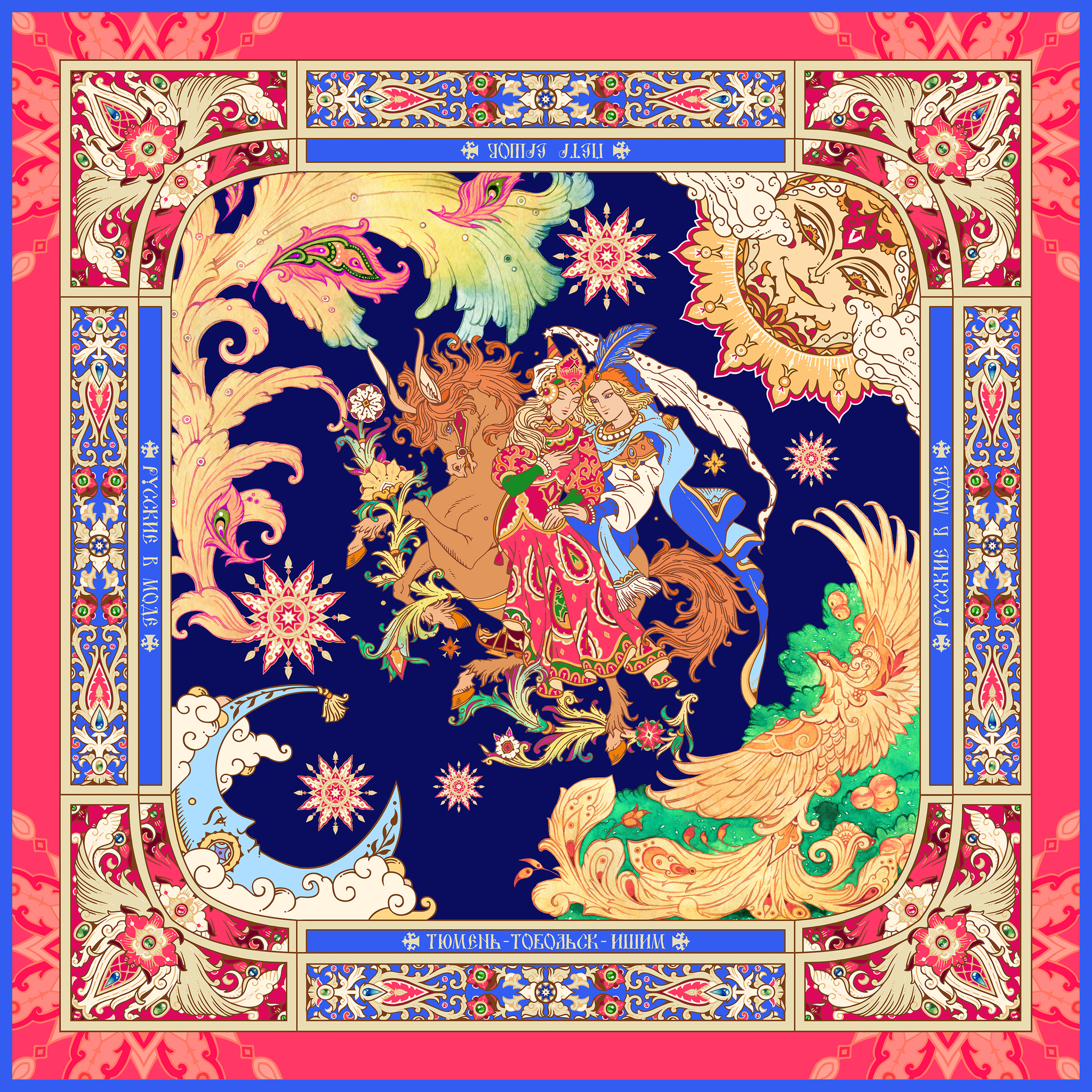
"The Little Humpbacked Horse" Scarf
"Beyond the mountains, beyond the forests,
Beyond the wide seas,
Not in heaven, but on earth,
There lived an old man in a village…"The familiar, melodious lines of the fairy tale "The Little Humpbacked Horse" seem to transport us back to the magical world of childhood. Their author, Pyotr Yershov, was born in the village of Bezrukovo, Ishim District, Tobolsk Governorate (now Tyumen Oblast). Yershov wrote the fairy tale poem "The Little Humpbacked Horse" in 1834, when he was only 18 years old. This is Yershov's most famous work, which by the early 20th century had become a classic example of children's literature.
The scarf's canvas depicts the heroes of this beloved childhood story: Ivan, the beautiful Tsar Maiden, and the magical Little Humpbacked Horse. The design conveys the symbolism of the literary work—the embodiment of characters who figuratively represent the collective archetype of the Russian worldview. The style of the design harks back to the finest example of Russian graphic art of the Art Nouveau era—the illustrations of Russian fairy tales and epics by artist Ivan Bilibin.
The "Little Humpbacked Horse" scarf was created by the "Russians in Fashion" brand in collaboration with the Tyumen Region Ministry of Tourism as part of the region's image and territorial brand. According to the government's vision, the image of the Little Humpbacked Horse should become the main tourist symbol of the Tyumen Region—the birthplace of Pyotr Yershov.
Little Humpbacked Horse. Designer: Nina Ruchkina, artist: Mila Losenko. 90x90 cm.
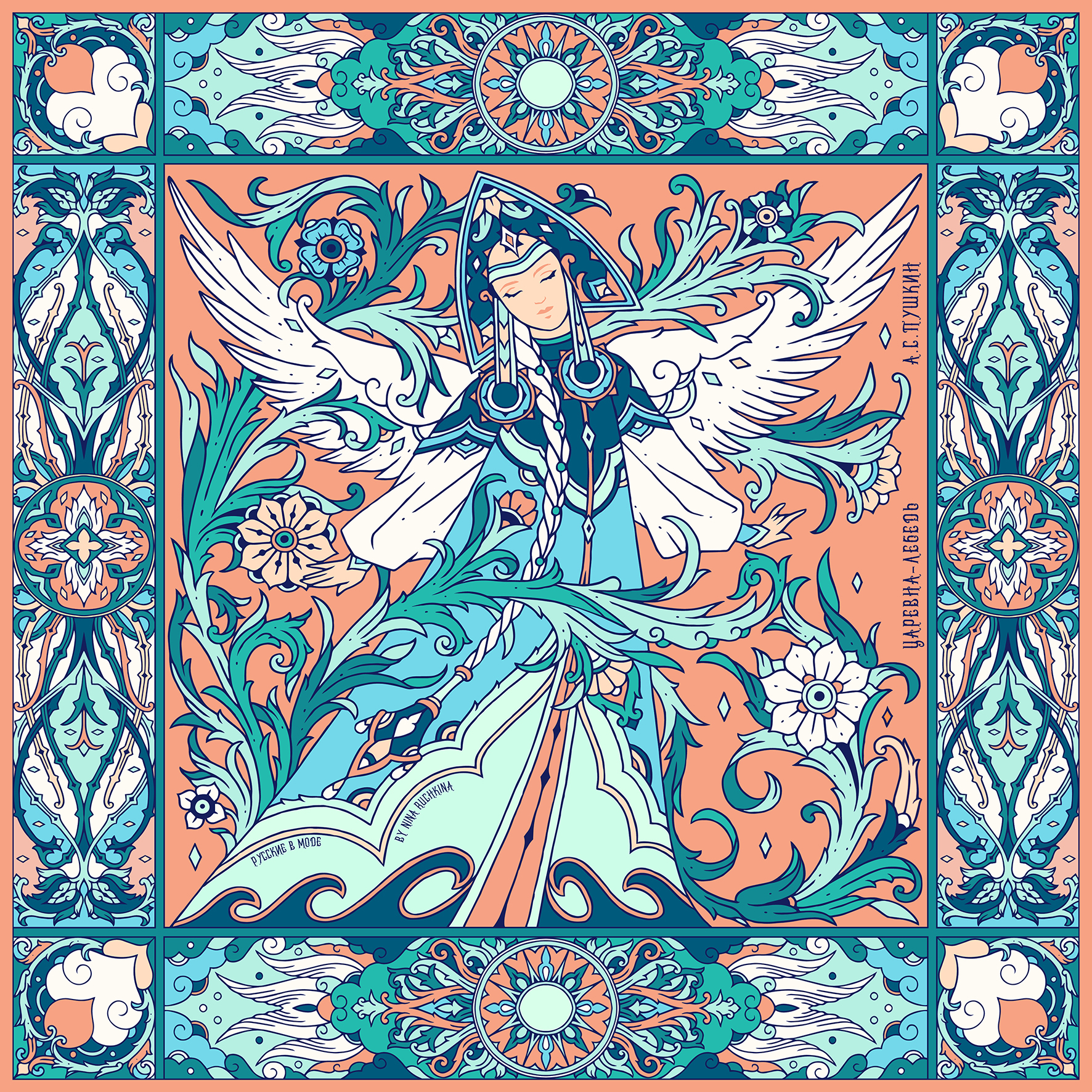
"Swan Princess" Scarf
This scarf embodies the fairytale princess, made famous by the great poet Alexander Pushkin. He was the first to give the world sublime literary examples of Russian aesthetics, rooted in folk traditions and folklore.
The scarf's design is executed in a decorative and graphic style characteristic of Art Nouveau. The princess, with her snow-white wings, embodies virtue, wisdom, and enchanting beauty. And when transformed into a bird, she is capable of achieving unprecedented heights, illuminating the world with her splendor. The original combination of delicate tones, floral patterns, and Russian flavor makes the design particularly timeless.
Swan Princess. Designer Nina Ruchkina, artist Mila Losenko. 90x90 cm
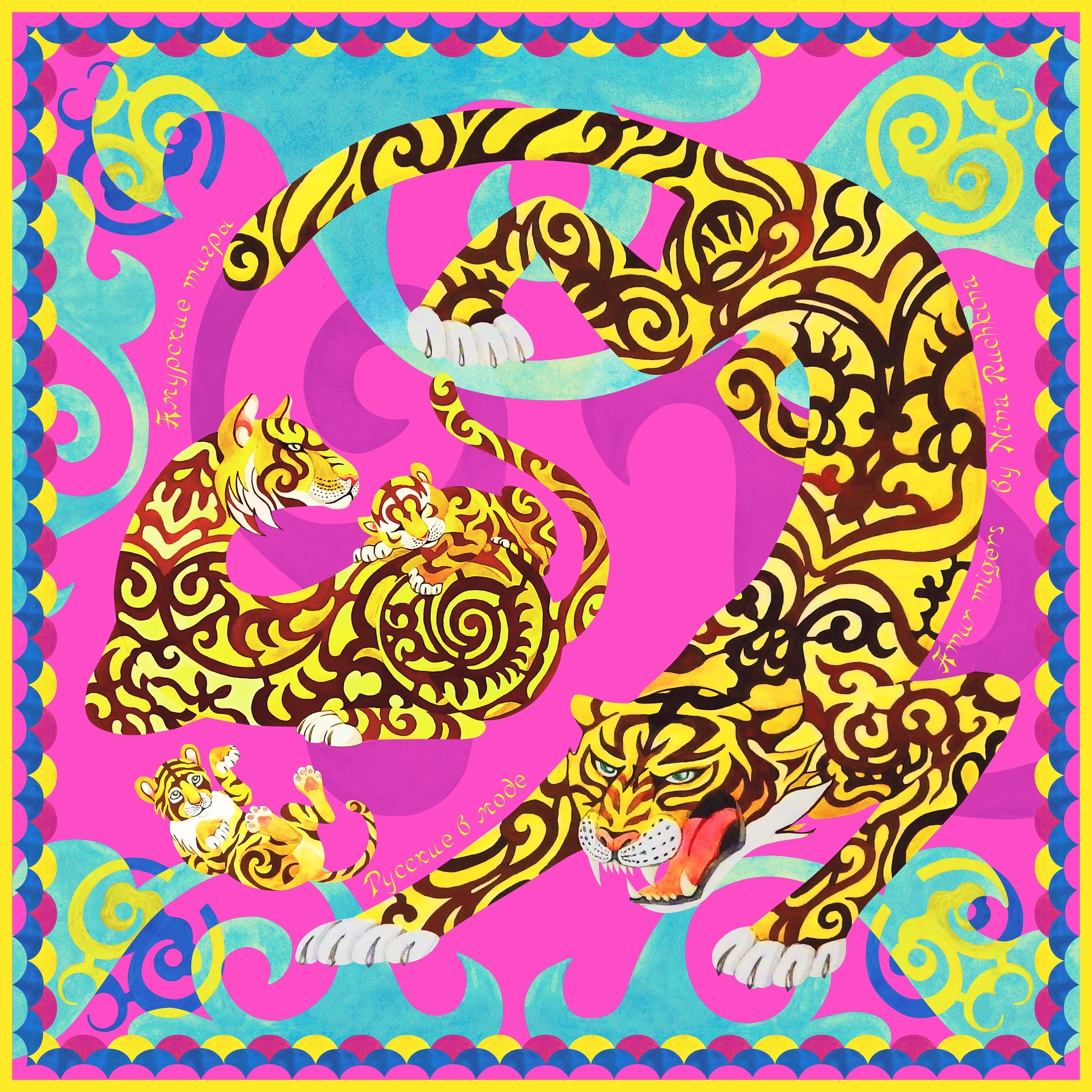
"Amur Tigers" Scarf
The design is based on the illustrations by the world-renowned Khabarovsk artist G.D. Pavlishin for D.D. Nagishkin's book "Amur Tales" (published in 1946, illustrated in 1975) – an artistic retelling of the folklore of the indigenous people of the Amur region.
The central feature of the composition is the stylized images of Amur tigers – a particularly rare representative of the feline family. Their coloring is inspired by the spiral-ribbon patterns of the Nanai people, a people who have always been distinguished by their keen aesthetic understanding of the world. The pattern evokes the idea of development and the cyclical nature of life and echoes the geometric rhythm of the pattern adorning the border of the fabric.
The design was created in collaboration with the Amur Tiger Center, established by the Russian Geographical Society at the initiative of Russian President Vladimir Putin.
The "Amur Tigers" scarf received letters of thanks from A.A. Abrosimov, Acting Minister of Industry and Trade of the Khabarovsk Territory, and M.V. Degtyarev, Minister of Sport of the Russian Federation and member of the State Council of the Russian Federation.
Amur Tigers. Designer Nina Ruchkina, artist Anna Tumashova. 90x90 cm
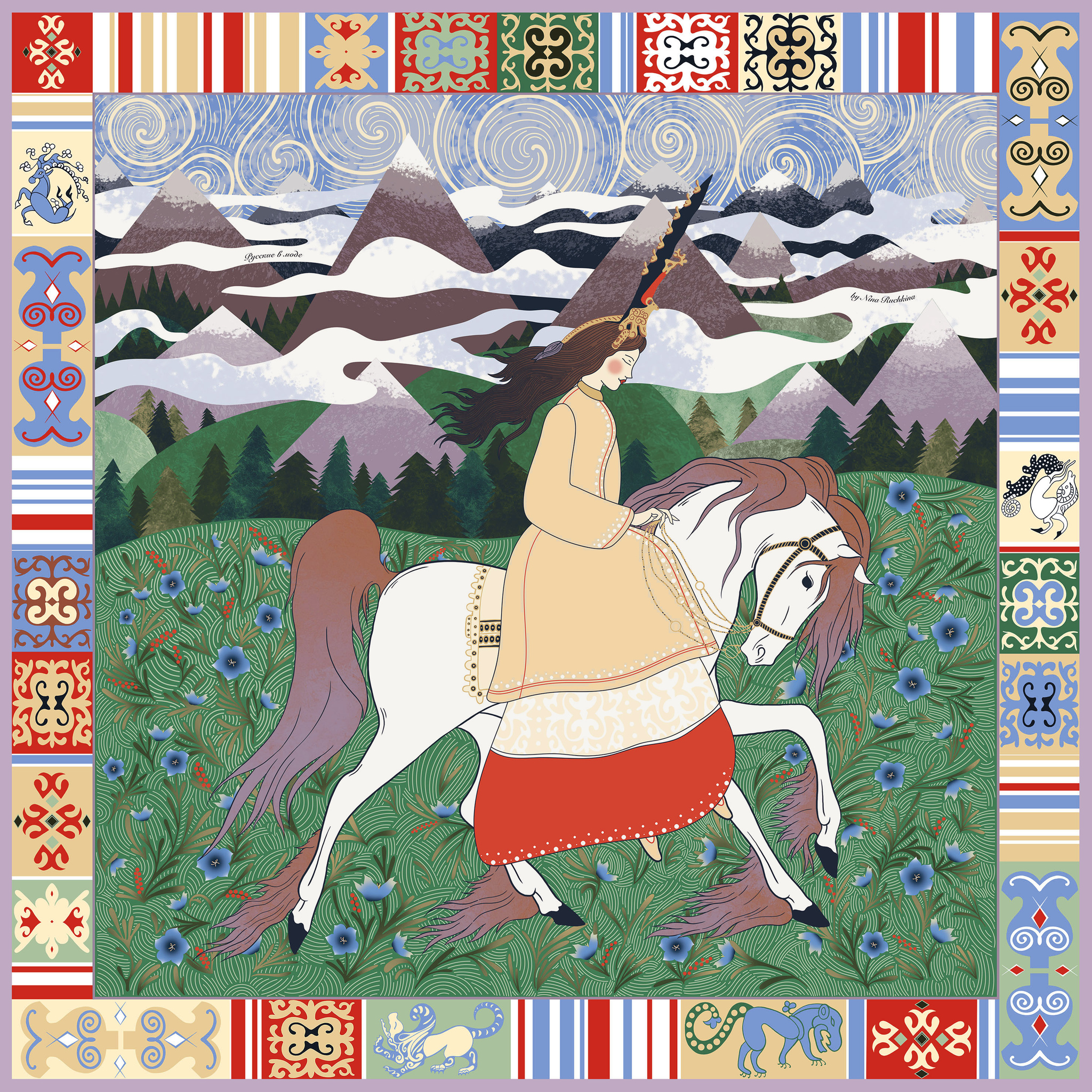
Scarf "Feminine Face of Altai. Spring"
The canvas depicts a metaphorical embodiment of feminine power, linked to Altai mythology. According to Altai legends, every woman is the daughter of the Great Mother, Umai Ene, and like her, is endowed with the ability to transform the world. The scarf's main image also incorporates the traits and attributes of the Altai princess, referencing real archaeological finds.
Umai Ene's daughter is depicted against a landscape backdrop, riding a sacred white horse, symbolizing spiritual purity and heavenly blessing. The spring meadow is associated with a time of rebirth and growth, while the majestic mountains symbolize the axis mundi and Altai itself. The scarf's ornamental frame consists of 20 patterns—a "protective field" containing the wisdom of generations.
Feminine Face of Altai. Spring. Designer Nina Ruchkina. 90x90 cm
Section II, "Arts and Crafts of Russia"
displays works based on the applied folk art traditions of our country's artisans. These are now popular souvenirs and world-renowned symbols of Russian heritage.
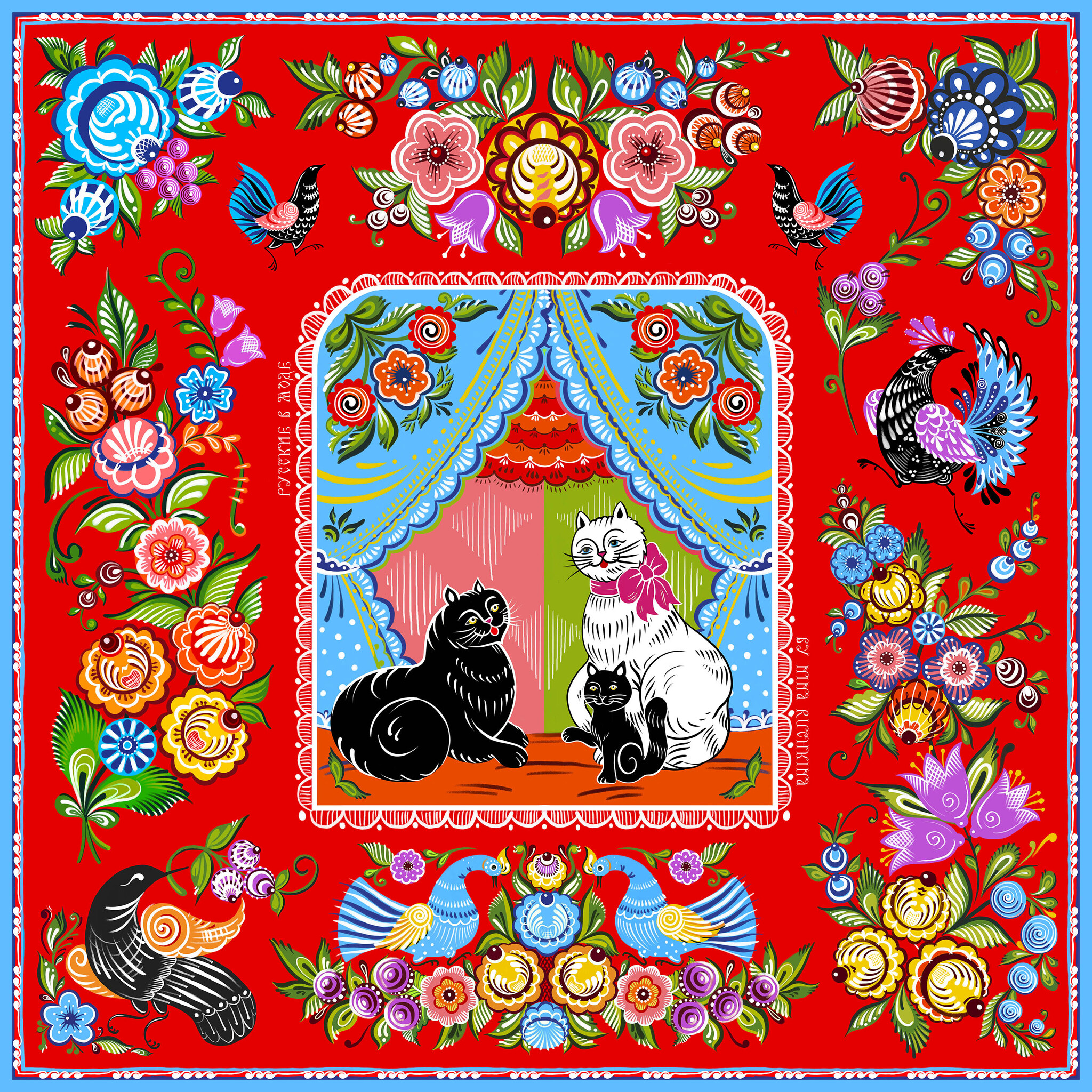
Gorodets Painting Shawl
Gorodets painting is a famous Russian folk art craft that originated in the mid-19th century in the Nizhny Novgorod province, near the town of Gorodets. Gorodets painting is executed on wood and is distinguished by a unique pictorial language expressed in stylization, rich colors, lush patterns, and especially the transformation of natural motifs. Today, the art of Gorodets painting is extremely popular and widely known.
The Gorodets Painting Shawl features the characteristic symbolic painting of the Gorodets craft. The unified decorative pattern of the canvas creates a festive mood: from the contrasting colors to the vibrant colors inherent in the masterpieces of Gorodets painting.
At the center of the composition are "cats-on-the-window," symbolizing comfort and family life. The piece is decorated with images of birds, which bring happiness and prosperity, while daisies, bells, and roses are arranged in picturesque bouquets, symbolizing prosperity.
Gorodets painting. Designer: Nina Ruchkina, artist: Anna Shulik. 90x90 cm
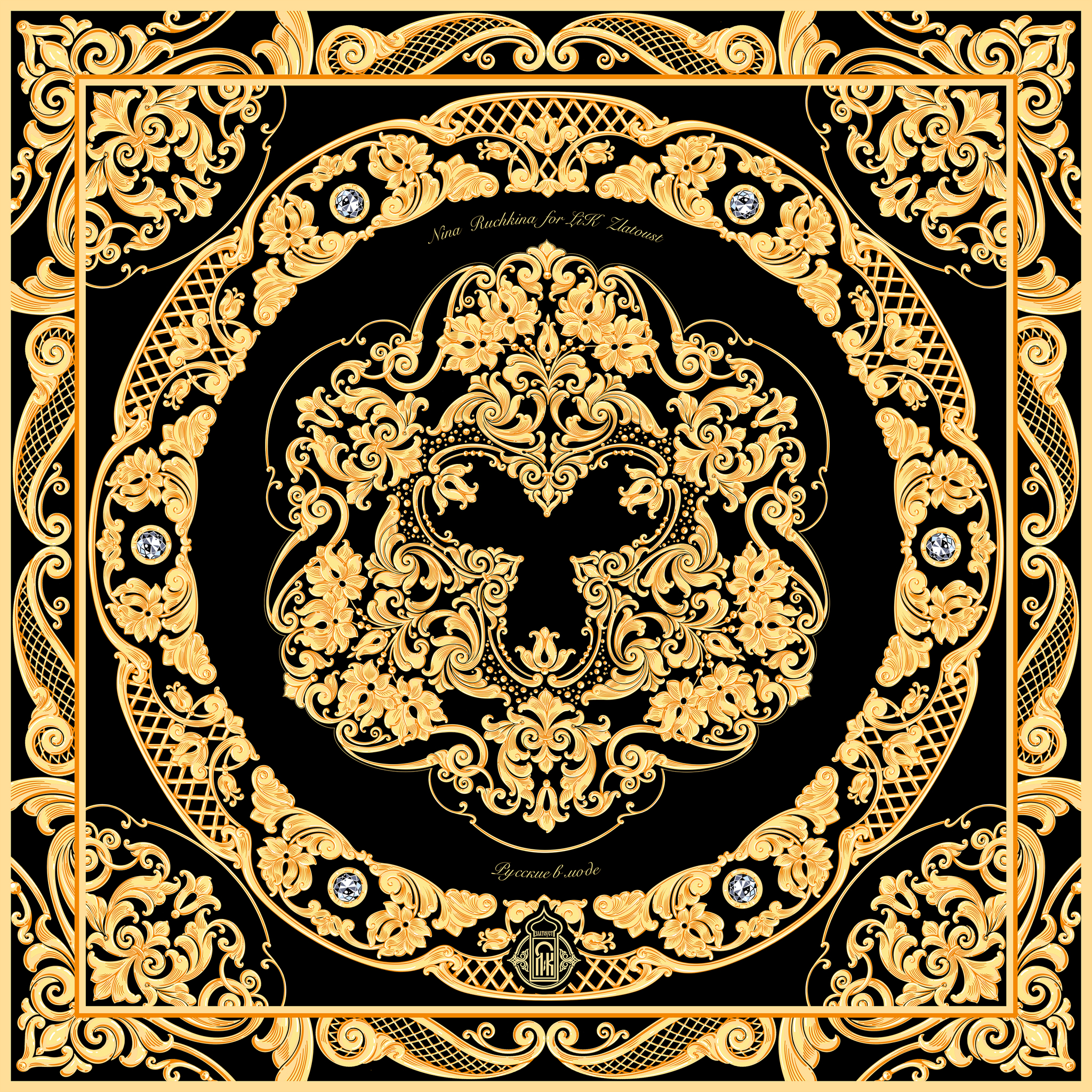
"Zlatoust Engraving" Scarf
The South Ural city of Zlatoust (Chelyabinsk Region) is rightfully considered the capital of a rare art form: artistic steel engraving. This world-renowned folk craft dates back to the early 19th century, when Zlatoust began to excel in the production of decorated bladed weapons and artistic engravings.
Artists exploit the wonderful properties of steel, nickel, silver, and gold, applying special treatments to create unique pieces.
The "Zlatoust Engraving" scarf features an expressive contrast of gold and black—a distinctive method of decorating images. The design visually reproduces the technique of blackening metal followed by gilding and inlay. The scarf's exquisite ornamentation is one of the most popular pictorial motifs of the Zlatoust craft.
Zlatoust Engraving Designer Nina Ruchkina, artist Olga Balaka. 90x90 cm
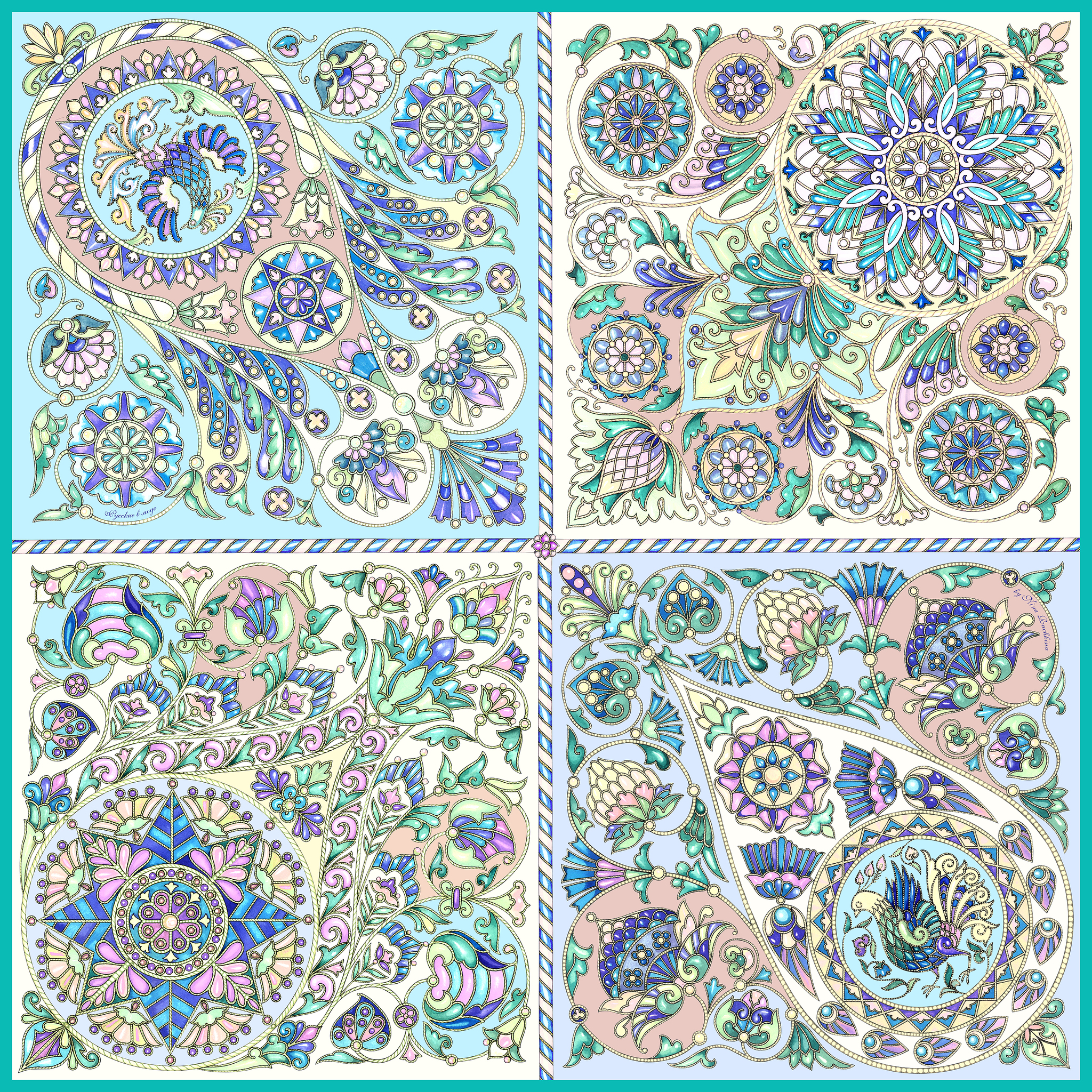
"Russian Enamel" Scarf
Inspired by the ancient Russian craft of hot enamel painting on metal.
The works of Russian enamel masters have long been renowned for the exquisite design and extraordinary variety of colors. Beginning in the 11th and 12th centuries, enamel was used to decorate jewelry, tableware, books, and other items. Vibrant blue, red, green, and light blue colors were especially harmoniously combined with precious stones and metals in the creations of the renowned master jeweler Carl Fabergé.
The complex system of multicolored decoration and the openwork composition express the spirit of Russian creativity and embody the beauty of the national artistic tradition.
Russian Enamel. Designer Nina Ruchkina, artist Mikhail Ivanov. 90x90 cm
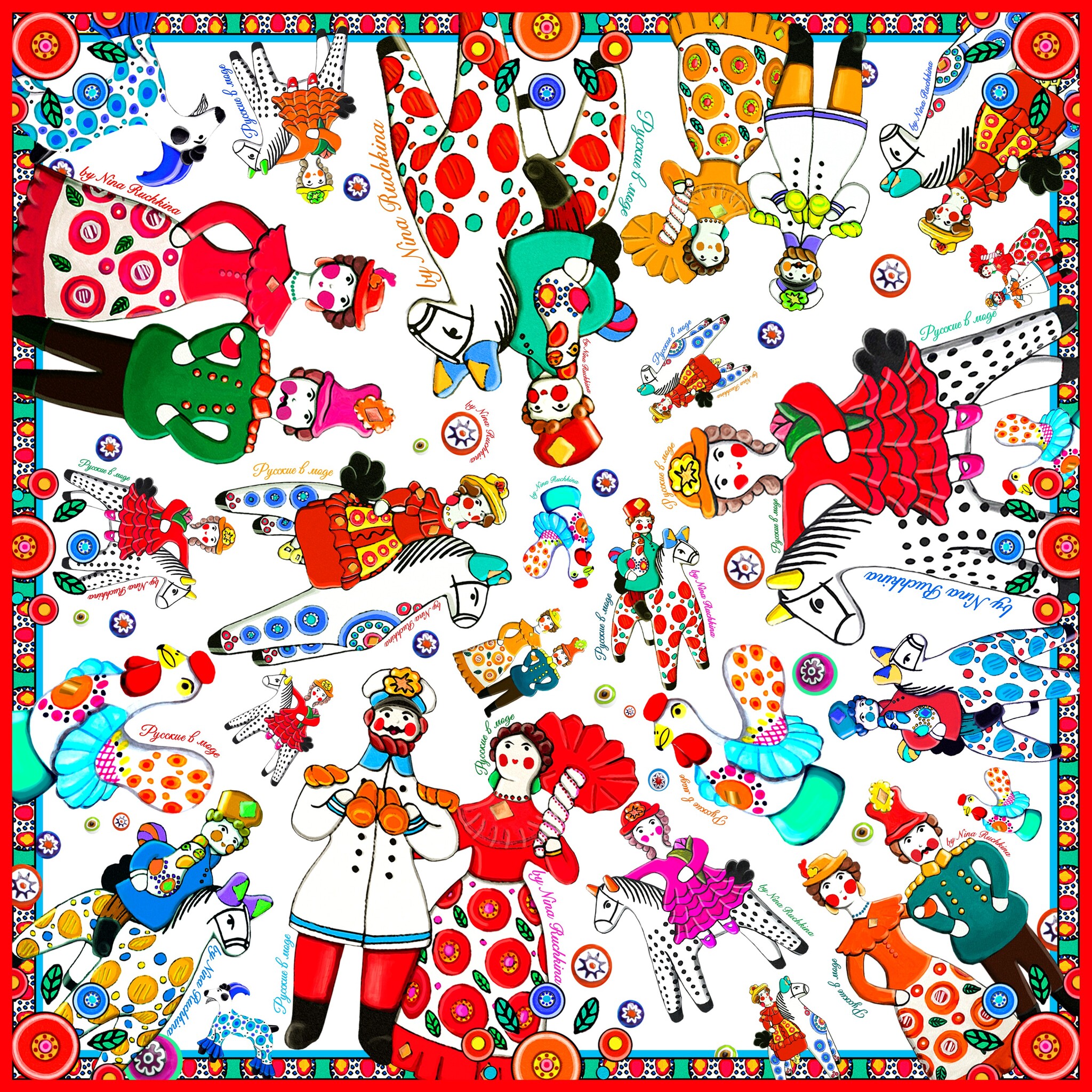
"Dymkovo Toy" Shawl
Dymkovo toys are one of Russia's oldest crafts, originating in the village of Dymkovo (now Kirov) in the 16th century. Elegant and cheerful, they seem to embody joy and enthusiasm. The shawl's design, featuring sweet and heartfelt images, conveys a blissful mood. Rich, deep colors, the sincerity and warmth of folk art—Russia's history has never been so expressive and eloquent.
Dymkovo Toy. Designer Nina Ruchkina. 90x90 cm
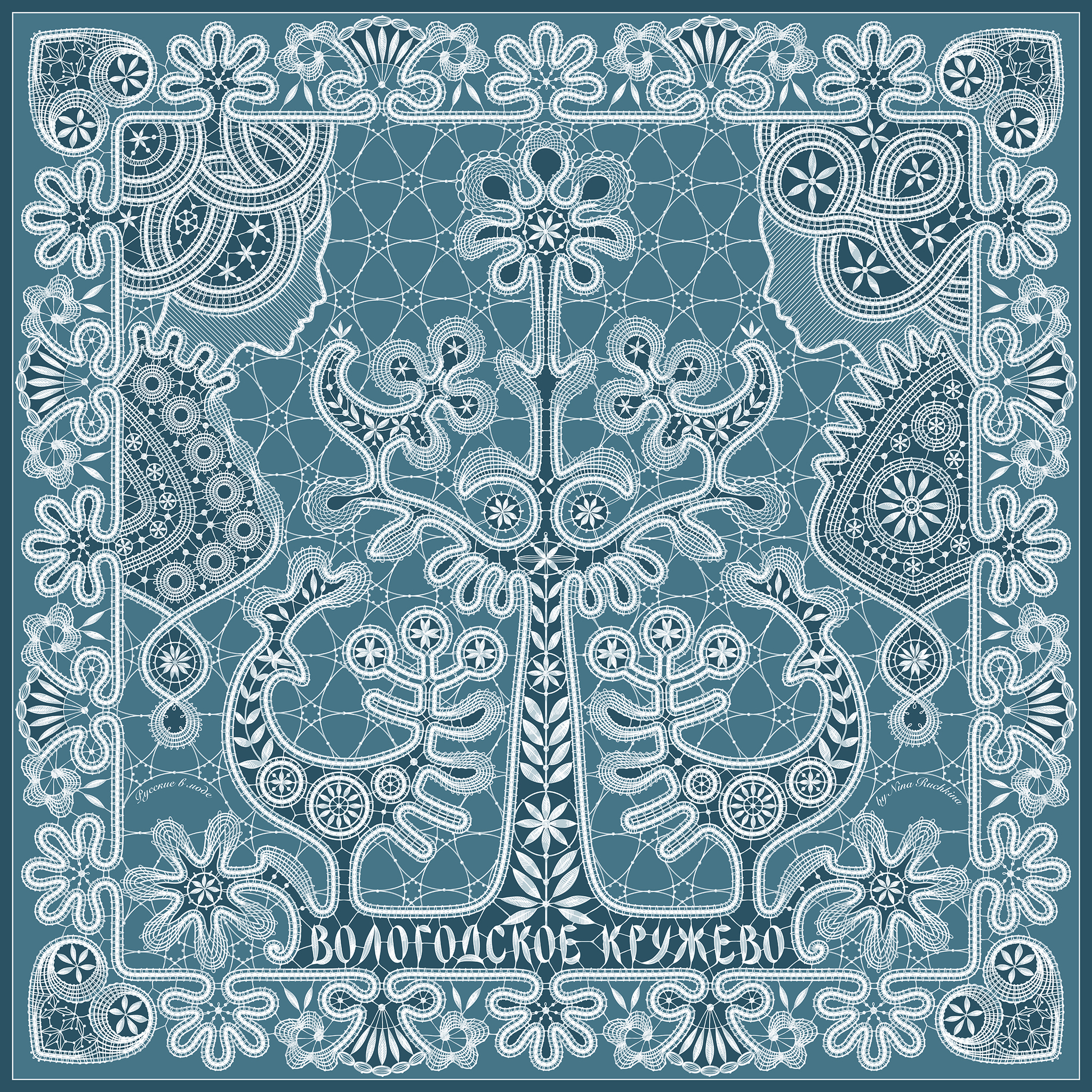
"Vologda Lace" Shawl
Vologda lace is one of the world's most renowned lace crafts, being one of the most renowned crafts of the Russian North. Its distinctive features emerged in the 17th and 18th centuries: a penchant for archaic elements, expressive patterns of five- and seven-leaf flowers woven with white filigree, the obligatory division of the lace into pattern and background, the purity and virtuosity of the lines, and the meticulous execution of the details.
The "Vologda Lace" shawl is dedicated to a unique phenomenon in folk art, linked to the secrets of Vologda lace artisans. Like a frosted pattern on glass, the image of the fabric unfolds, consisting of a delicate, snow-white pattern on a turquoise background. Fabulous peacocks, marvelous cinquefoil flowers, delicate rosettes, swirling garlands, and female silhouettes in the upper registers are depicted with graceful, gossamer lines. In the center is a stylized tree of life, reminiscent of a large flower on a straight stem—a symbol of spring and renewal. The iconography of the ancient "tree and peacocks" motif has a long tradition, dating back to folk embroidery, which has been perfected in lace by Vologda craftswomen. The background lattice is made up of small oval overlays, which also fill the figures.
The "Vologda Lace" scarf in silk conveys the unique character of Vologda handicrafts, renowned for their incredible beauty and meticulous craftsmanship.
Vologda Lace. Designers Nina Ruchkina and Natalia Alexandrova. 90x90 cm
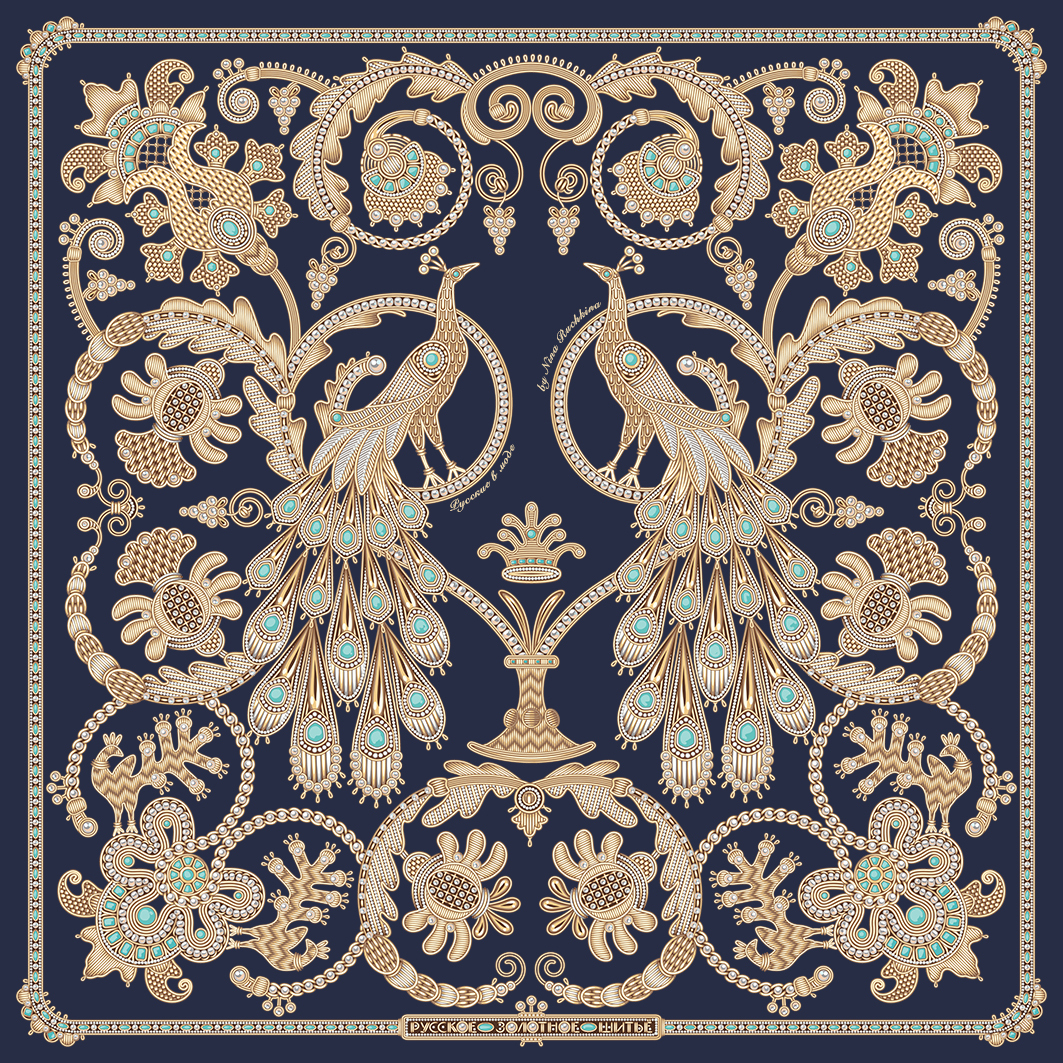
"Russian Gold Embroidery" Scarf
The "Russian Gold Embroidery" scarf is dedicated to an ancient Russian craft – decorative and ornamental hand embroidery with gilded and silver threads. Gold embroidery has been known in Rus' for over a thousand years. The ancient embroidery artifacts that have survived to this day, crafted by Russian artisans, are works of the highest level of craftsmanship and beauty.
The design of the "Russian Gold Embroidery" scarf reproduces the techniques and patterns of traditional embroidery. The centerpiece features regal peacocks, known in Rus' as "Firebirds" – symbols of happiness, abundance, and the fulfillment of wishes.
Russian Gold Embroidery. Designer Nina Ruchkina, artist Natalia Alexandrova. 90x90 cm
Section III "State Symbols of Russia"
covers national history, traditional spiritual and moral values, and guidelines.
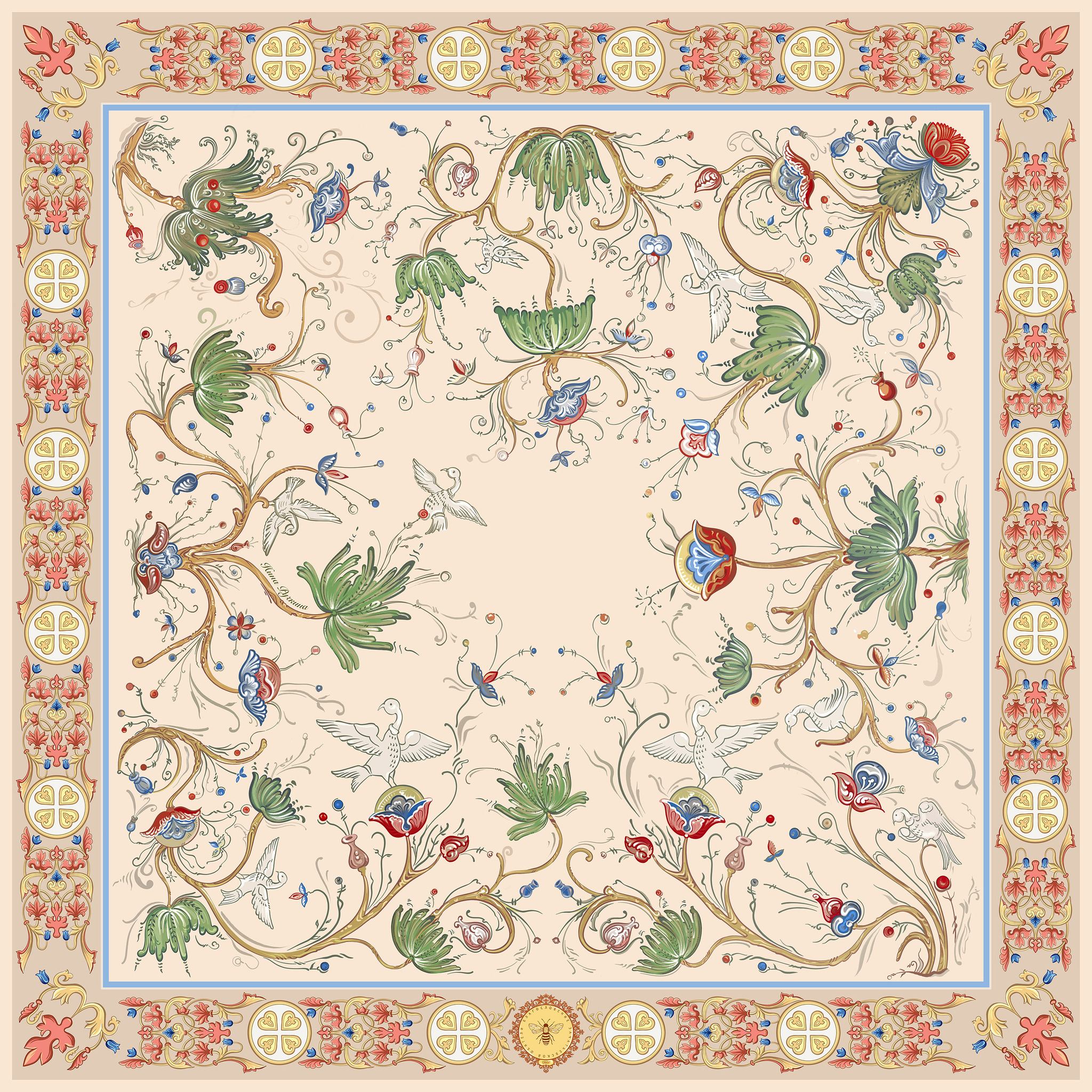
Scarf "Conception Painting. Garden of Eden"
This scarf depicts the Cathedral of the Nativity of the Blessed Virgin Mary at the Conception Monastery (Moscow), executed in the traditional Russian "uzorochye" style, following 17th-century designs. The monastery currently houses many relics, to which prayers are addressed for the happiness of the home and motherhood.
The canvas carefully reproduces the fresco painting from the cathedral's right wing. Simultaneously modern and original, it seems to unite Russian faith and Russian folklore in a spatial space of forms. Palmette petals, resembling sunbeams, delicately curved stems, graceful inflorescences, and birds of paradise form an ethereal ornament filled with grace. The composition is completed by an openwork frame with Christian floral symbolism and an image of a honeybee.
Conception Painting. Garden of Eden. Designer Nina Ruchkina. 90x90 cm
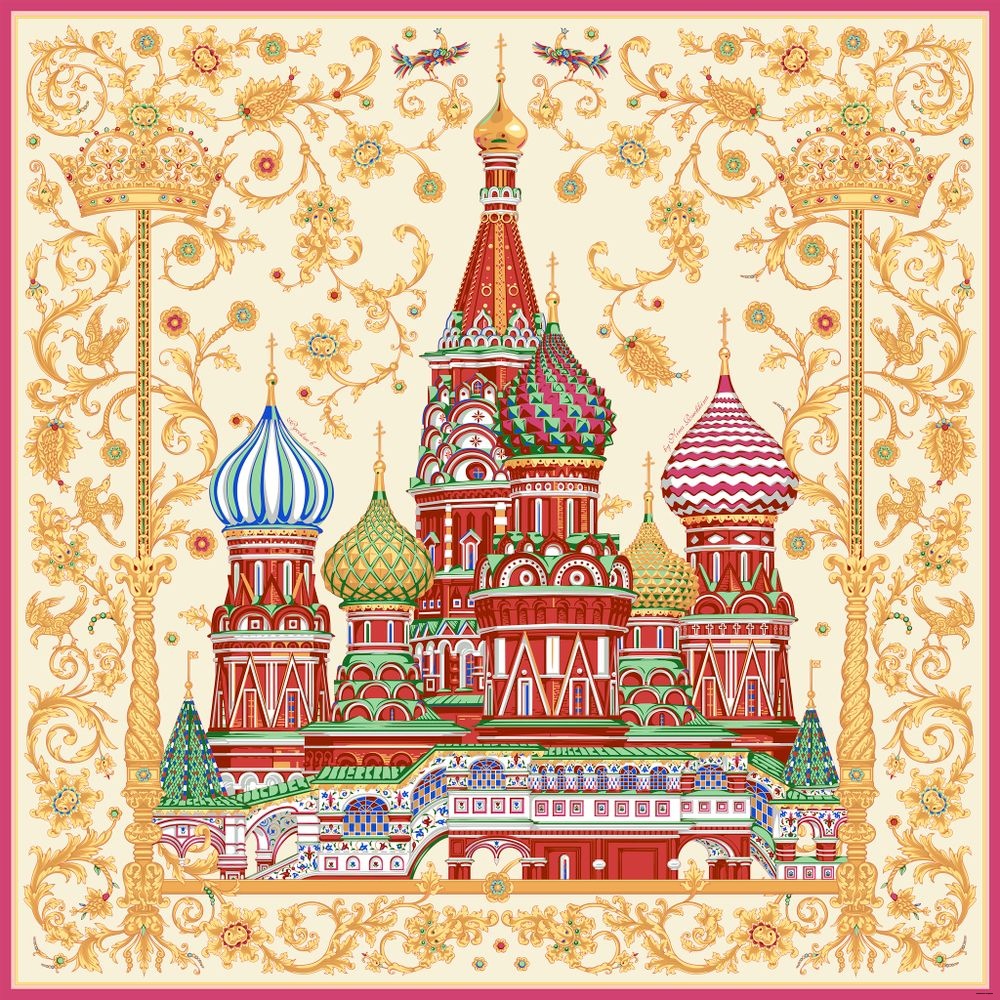
St. Basil's Cathedral Scarf
"A cluster of small towers of varying heights, forming together a bush, a bouquet of flowers... or, even better, a multicolored crystal, its smooth facets sparkling brightly in the sun's rays..." These are the words of the French traveler Custine Astolphe, who wrote a book about the history of Russia in 1839 and very accurately described the famous St. Basil's Cathedral.
St. Basil's Cathedral, also known as the Cathedral of the Intercession on the Moat, is one of the beautiful architectural landmarks of Red Square and a symbol of the Russian capital. This unique architectural monument was erected in the mid-16th century by order of Ivan the Terrible to commemorate Rus''s victory over the Kazan Khanate. The cathedral unites 11 churches with colorful domes of varying heights, forming the distinct shape of the eight-pointed Star of Bethlehem—a symbol of the Virgin Mary.
St. Basil's Cathedral Designer Nina Ruchkina, artist Natalia Aleksandrova. 90x90 cm
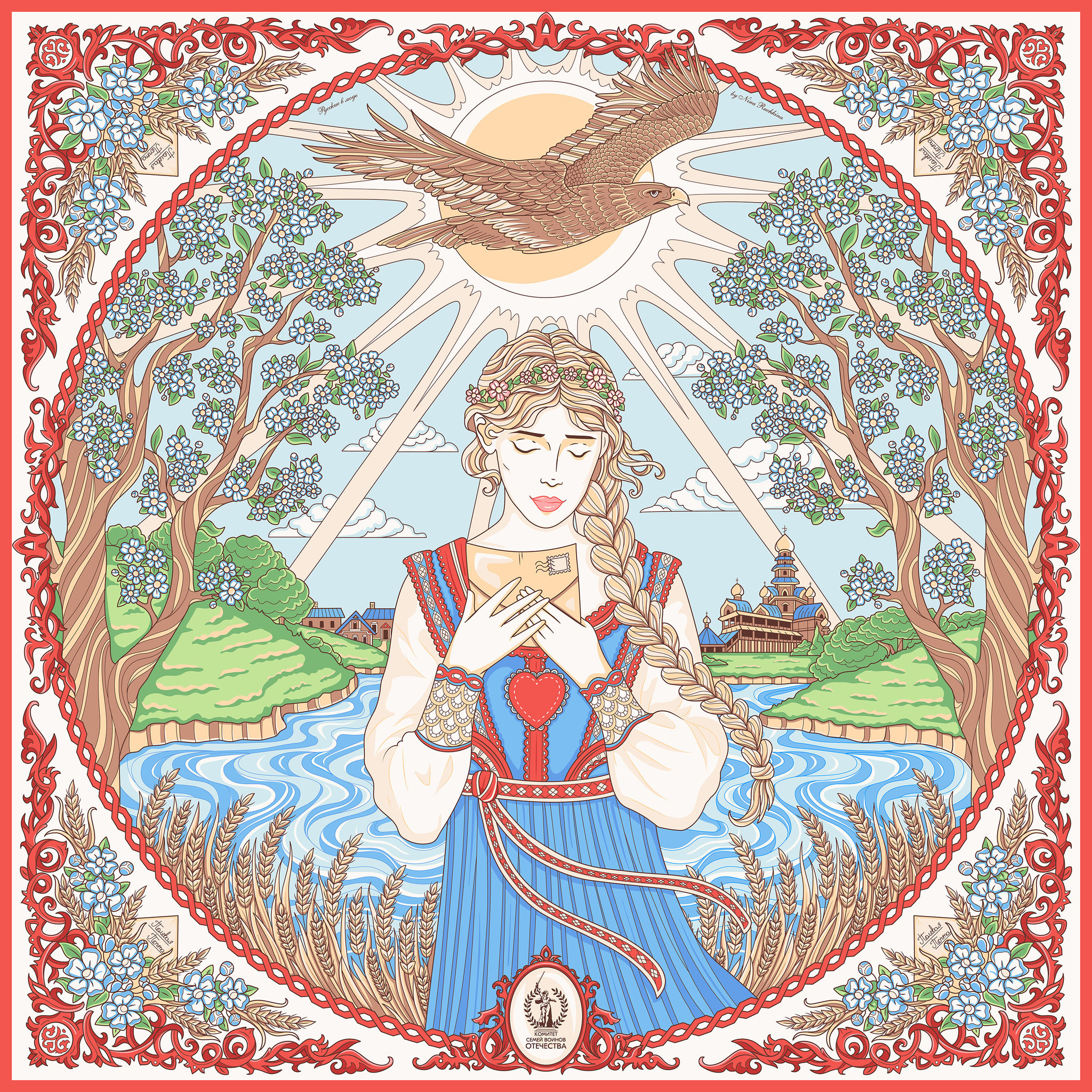
"Katyusha" Scarf
Apple and pear trees were in bloom,
mists drifted over the river.
Katyusha came out onto the shore,
up the high, steep bank!The "Katyusha" scarf is dedicated to the song of the same name, which became a folk symbol during the Great Patriotic War. The scarf embodies the loyalty, beauty, and fortitude of the women of the victorious country.
A particular source of pride is the presentation of the first Katyusha to Russian President Vladimir Putin at a ceremony in the Kremlin Palace on Russia Day 2024.
Katyusha. Designer Nina Ruchkina, artist Valeria Razumova. 90x90 cm
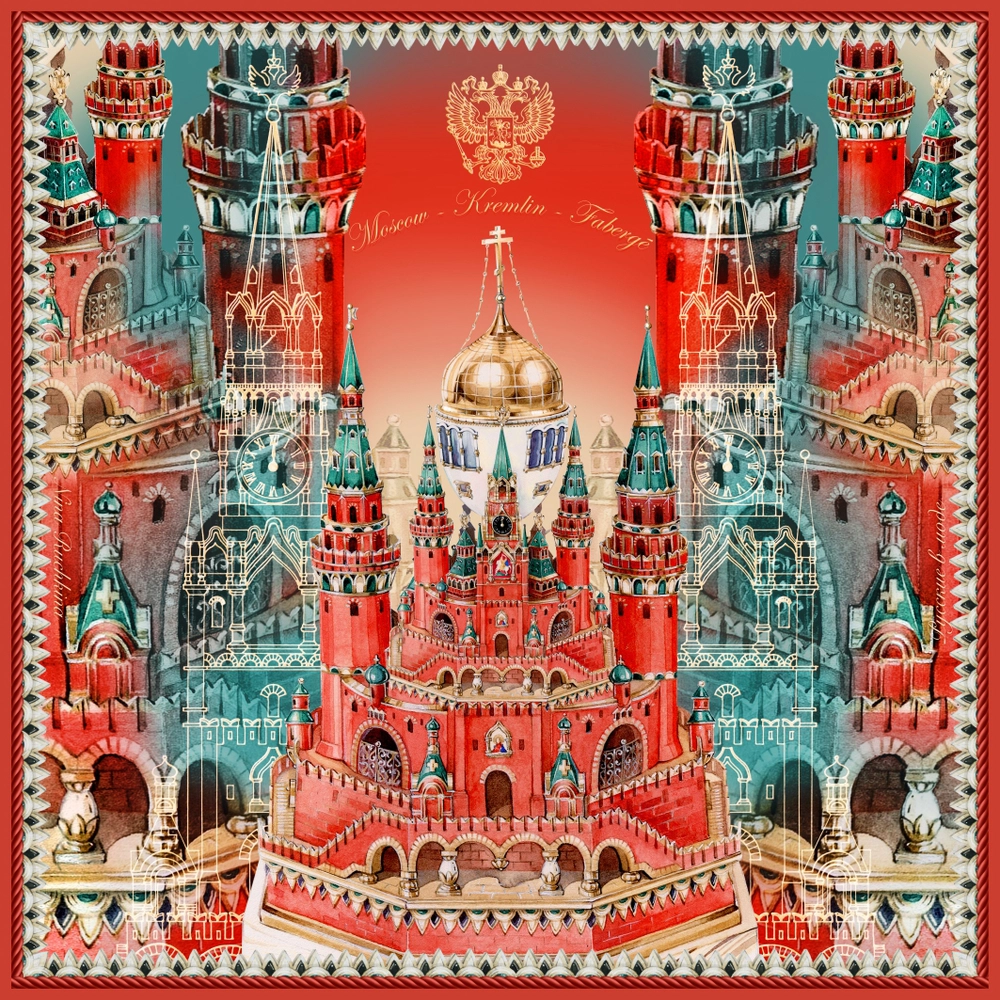
The "Kremlin-Moscow-Faberge" Scarf
This scarf is dedicated to the masterpiece of the outstanding Russian jeweler K.G. Fabergé – the "Moscow Kremlin" Easter egg, commissioned by the Russian Imperial House in 1904-1906. This exquisite work, conceived by the master as the embodiment of a "symbol of power and spirituality," is now part of the collection of the Kremlin Armory.
The artists of "Russians in Fashion" have carefully and meticulously rendered Fabergé's "Moscow Kremlin" on the scarf. The central composition of the Kremlin and the Assumption Cathedral is complemented by images of architectural elements on each side, emphasizing the significance of each detail. The scarf is designed in the colors of the tricolor – the flag of the Russian Federation – with red predominating. The image is crowned with the Russian coat of arms, embodying the overall idea of continuity, triumph, and grandeur.
Kremlin-Moscow-Faberge. Designer Nina Ruchkina, artists Evgenia Teplyakova and Olga Balaka. 90x90 cm
Section IV "Dialogue of Cultures"
is dedicated to forms of intercultural communication based on respect and mutual understanding.
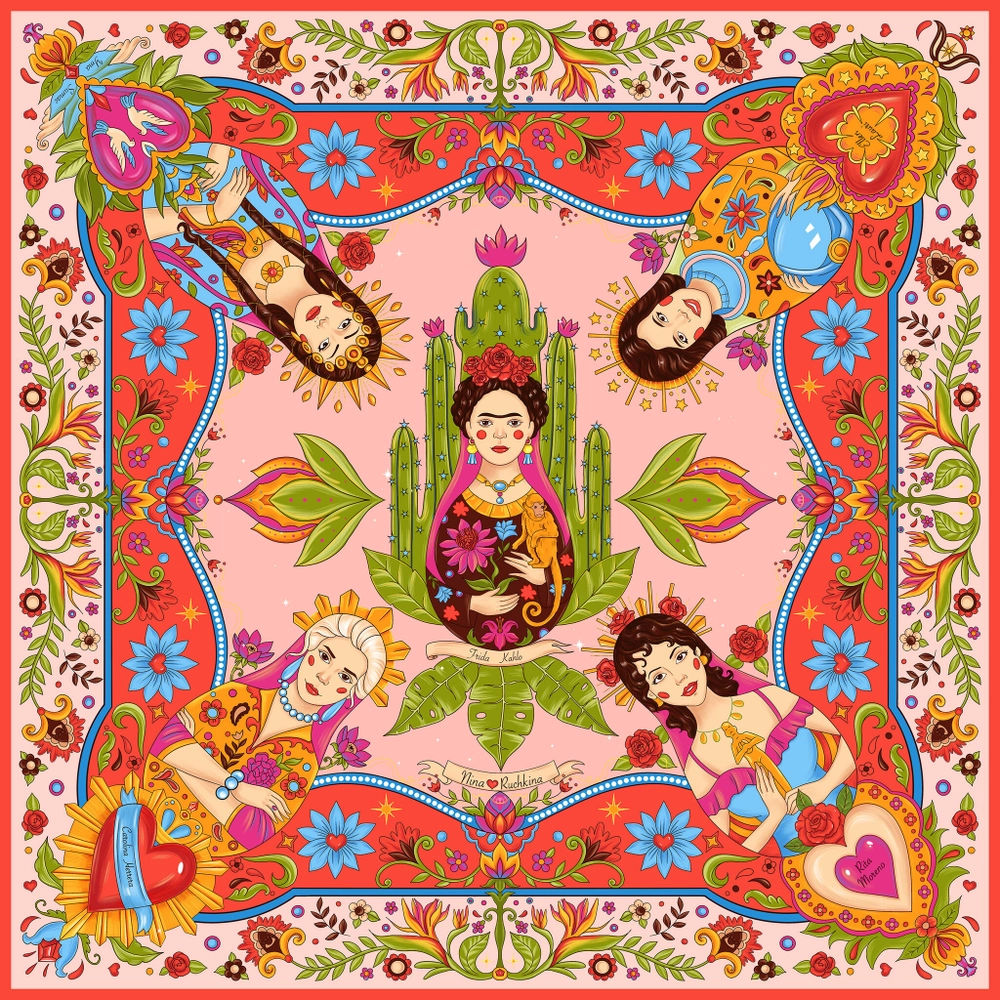
"Matryoshka Dolls. Latin America"
The "Matryoshka Dolls. Latin America" design is a hymn to the beauty and richness of the cultures of this distant continent and Russia, historically linked by friendship and partnership.
The canvas depicts images of famous Latin American women, stylized as Russian nesting dolls, emphasizing the idea of unifying feminine strength.
At the center of the composition is Mexican artist Frida Kahlo, a symbol of independence and great artistic talent. Flankers include Venezuelan fashion designer Carolina Herrera, renowned Puerto Rican actress Rita Moreno, legendary Peruvian singer Yma Sumac, and the first female astronaut of Latin American descent, Ellen Ochoa, of Mexican descent. The design is rich in decorative elements, including flowers, cacti, and Russian ornamental motifs. Images of hearts reference the visual traditions of Latin American countries, signifying compassion.Matryoshka Dolls Scarf "Latin America" embodies passion and devotion—in love, creativity, and career—it is a symbol of inspiration and the extraordinary creative potential of every woman in the world!
Matryoshka Dolls. Latin America. Designer: Nina Ruchkina, artist: Serafima Atayants. 90x90 cm
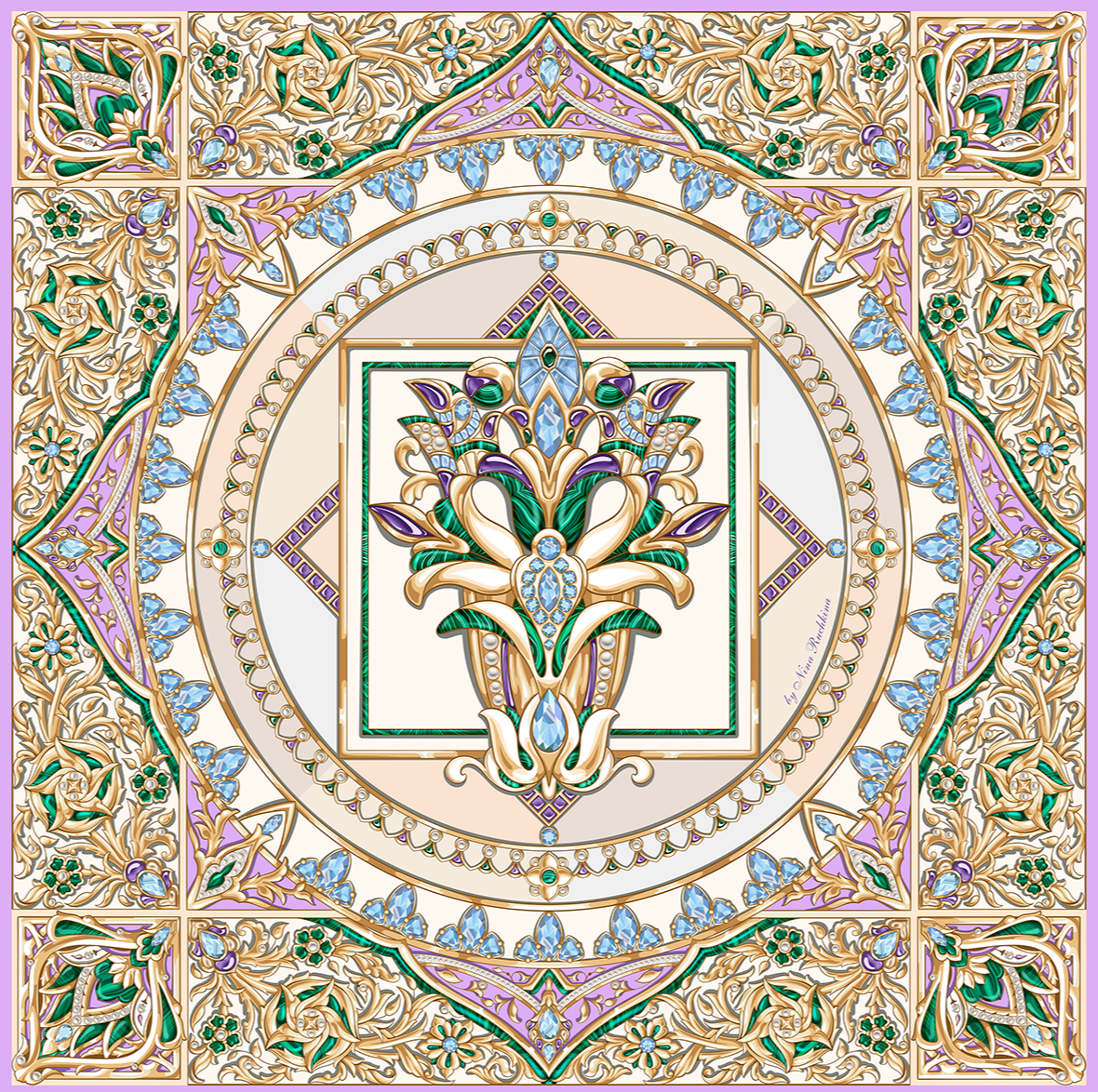
"Ural Arabesques" Scarf
This scarf was created as a diplomatic souvenir for the INNOPROM-2024 international exhibition. The concept of the scarf is intended to promote the cultural dialogue between Russia and the UAE. The fabric combines the magic of the East and the sacred mythology of the Urals, a region of Russia.
The design combines images of Ural gemstones and malachite with arabesque ornamentation, an integral part of the culture of the UAE and several indigenous peoples of the Urals. At the center of the composition is a stone flower—a symbol of creative exploration and self-improvement, celebrated by the renowned writer P.P. Bazhov. The flower is framed by oriental ornamentation and images of pearls, the primordial treasure of the United Arab Emirates.
Ural Arabesques. Designer and artist Nina Ruchkina. 90x90 cm
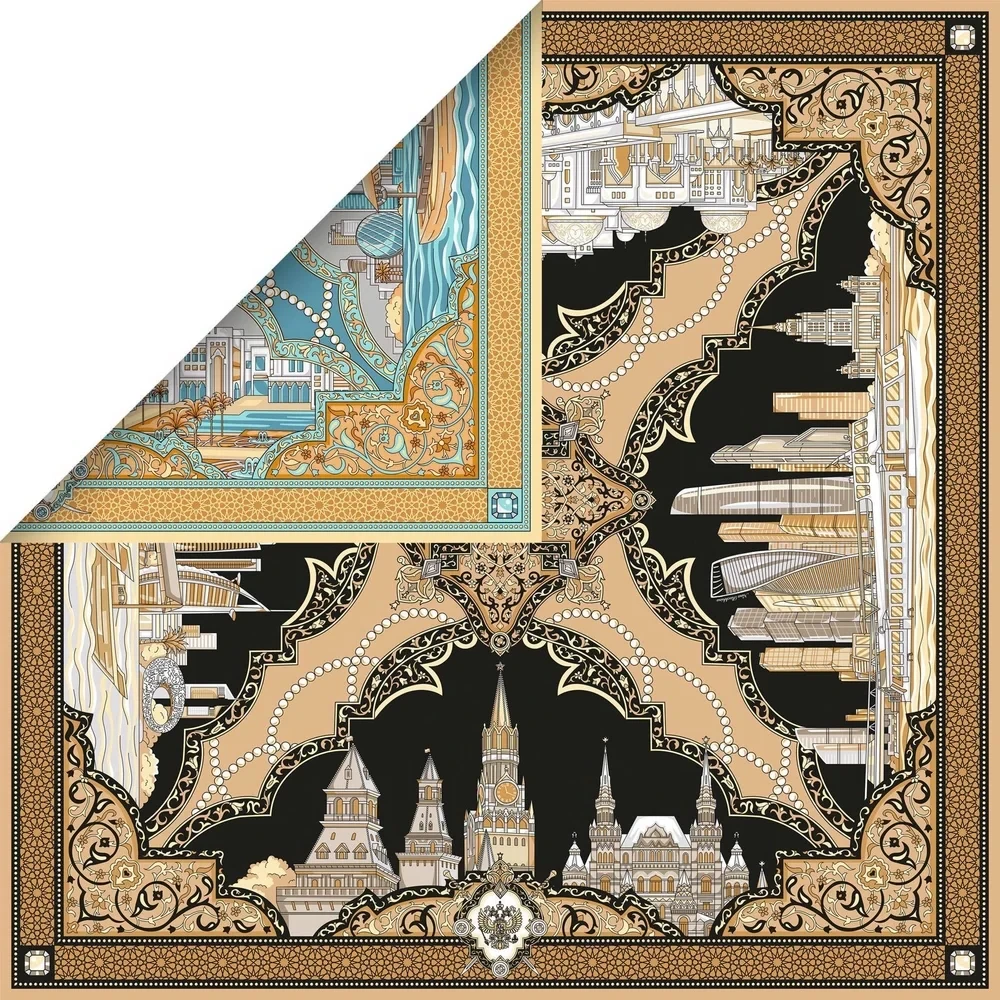
"Russia – UAE" Scarf
Created in collaboration with the UAE Embassy in Moscow. In recent years, relations between Russia and the United Arab Emirates have reached historic heights, steadily developing across all spheres.
The "UAE – Russia" scarf is inspired by world-renowned architectural masterpieces. Two panels of the scarf face the distinctive heritage of the two countries, showcasing the majestic ensembles of Moscow's Red Square and the Presidential Palace in Abu Dhabi.
The other two panoramas symbolize the closeness of Russia and the UAE in innovation – these depict the ultra-modern Moscow City complex and its surrounding areas. Views of the technological landmarks of Abu Dhabi and Dubai, including the famous skyscrapers – the Emirates Towers and the Burj Khalifa.
The central pattern combines paintings and the scarf's openwork frame into an oriental architectural element – the mashrabiya. The scattering of pearl strands in the mashrabiya emphasizes the elegance of the design and evokes the craft, which is significant for both the UAE and Russia.
Russia – UAE. Designer Nina Ruchkina, artist Valeria Razumova. 90x90 cm
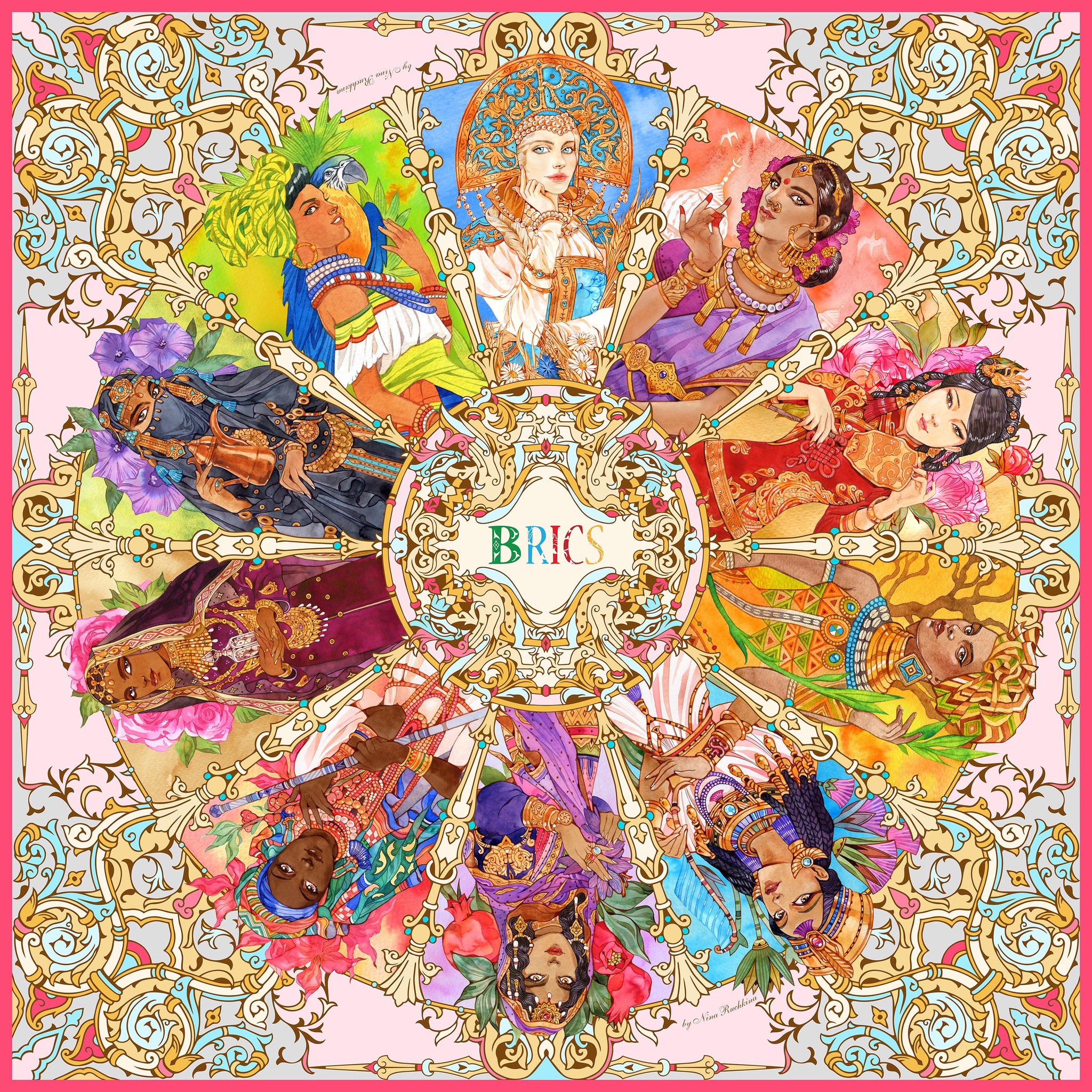
"BRICS 2024" Scarf
The "BRICS 2024" scarf is dedicated to Russia's year of presidency of the BRICS alliance. The Commonwealth is an intergovernmental union of the most dynamically developing major countries: Brazil, Russia, India, China, South Africa, Iran, Saudi Arabia, the UAE, Egypt, and Ethiopia.
The association includes a Women's Business Alliance, which inspired the design, illustrating the concept of a multipolar world and parity. It is no coincidence that the scarf depicts the participating countries as girls, dressed in stylized national costumes. The vibrant and distinctive female images form a circle, as if in a circle dance, symbolizing friendship and equality.
BRICS 2024. Designer Nina Ruchkina, artist Mila Losenko. 90x90 cm
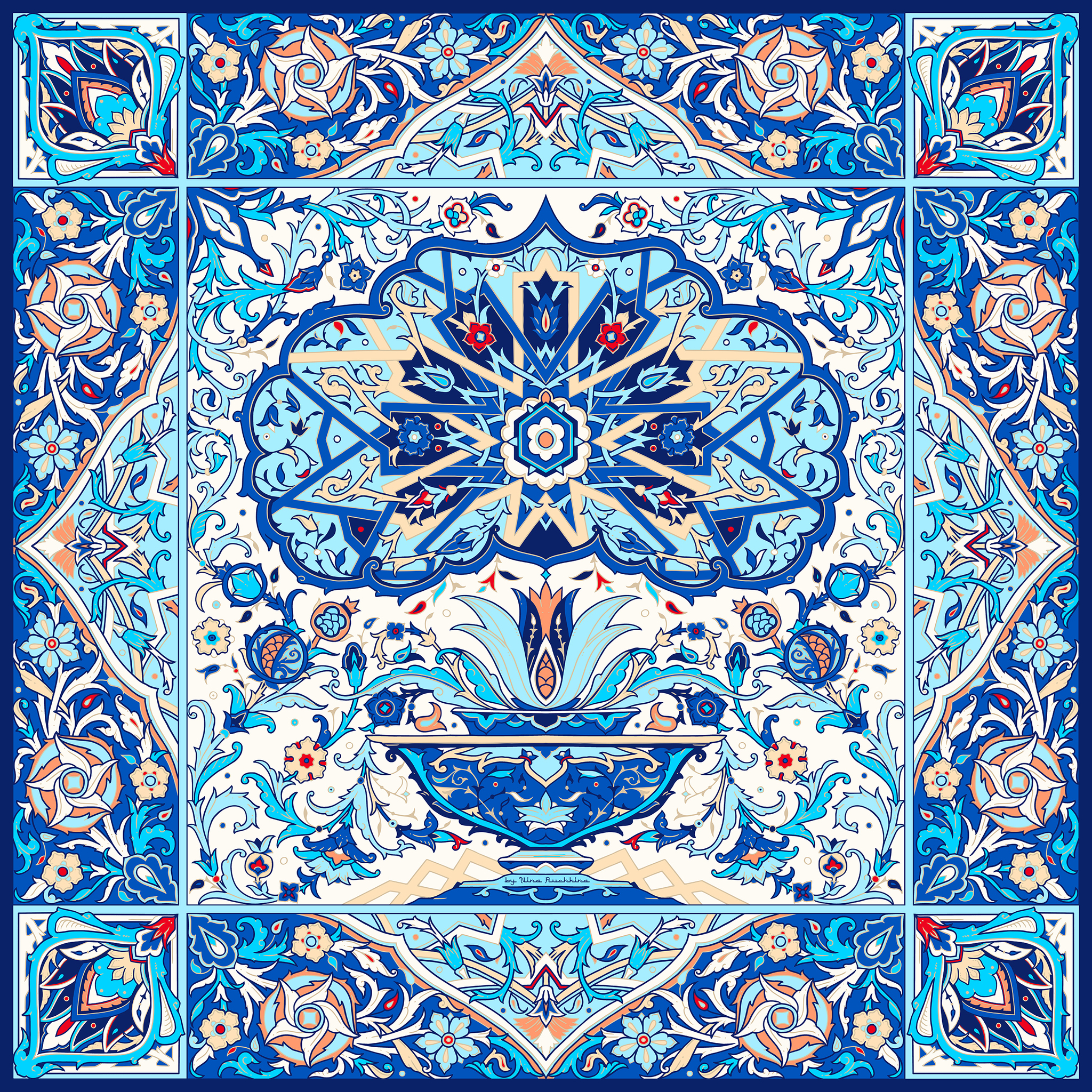
"Arabesque" Scarf
The design is inspired by the decorative elements of the majestic Kul Sharif Mosque in Kazan (Republic of Tatarstan). The motif is based on the traditional oriental "arabesque" pattern. It is based on repeated geometric shapes, calligraphic elements, and plant motifs, forming a complex ornamental interlacing. The endless transition from one pattern to another, with its dense filling of space, is poetically compared to the mesmerizing fabric of the universe, considered a connecting link between heaven and humanity.
Arabesque. Designer Nina Ruchkina, artist Mila Losenko. 90x90 cm
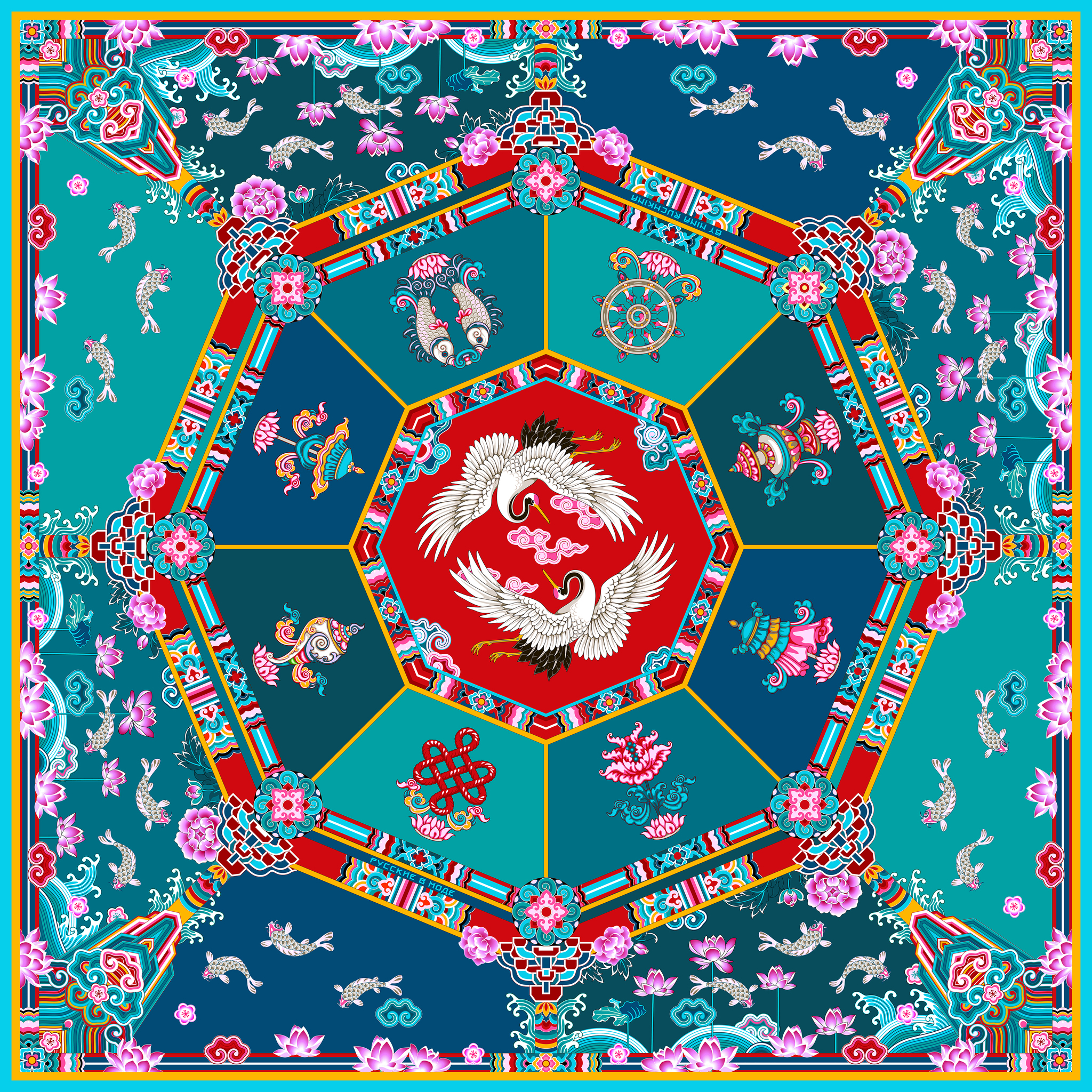
Ivolginsky Datsan Shawl
The Ivolginsky Datsan "Khambyn Khuree" ("Abode of the Wheel of the Teaching, Bringing Happiness and Full of Joy") is the largest Buddhist monastery located in the village of Verkhnyaya Ivolga, Buryatia. It is a magnificent architectural monument, which since 1945 has become a symbol of the revival of Buddhism in Russia, a place of spiritual development and cultural potential.
The "Ivolginsky Datsan" shawl appears to open a panoramic view of the monastery as seen from a bird's eye view. In the center is the multicolored, mottled roof of one of the buildings, decorated with Buddhist forms imbued with philosophical meaning. These eight auspicious symbols represent offerings made by the gods to Buddha Shakyamuni immediately after his attainment of Enlightenment: an umbrella, a pair of golden fish, a precious bumpa (vessel), a lotus, a white shell, an endless knot, a victory banner, and a golden wheel.
The pink lotuses on the canvas embody the image of Gautama Buddha, personifying purity of thoughts and tranquility, while a pair of cranes symbolizes longevity. The image is completed by numerous fish in the azure waters, signifying happiness. The scarf can be used for meditation or blissful contemplation.
Ivolginsky Datsan. Designer Nina Ruchkina, artist Natalia Aleksandrova. 90x90 cm